
Future of Design Cambridge 2026 – Report
Authors: Daniel Dalton and David Knight, 1st April 2026
The IABSE British Group was delighted to host Future of Design Cambridge 2026 on 24 March at the Department of Engineering, University of Cambridge – marking the first time the series has returned to Cambridge since 2005. Around 40 attendees, drawn from students, researchers, and practising engineers gathered for a full day of talks, paper presentations, a panel discussion, and networking.
The day opened with a keynote from Simon Smith of Smith and Wallwork, who shared his experience of material innovation in structural engineering, including his work on contemporary timber projects and the ongoing restoration of the Faculty of History Stirling Building – a complex and historically significant refurbishment that illustrated the creative and technical demands of working within the constraints of a beloved piece of architectural heritage.
Niamh McCloskey of Curtins then delivered an impassioned keynote on sustainability and carbon reduction, challenging everyone in the room to think more urgently about the profession’s responsibility in the face of the climate emergency. Her talk drew on her work as a chartered structural engineer and sustainability specialist, and her involvement with the IStructE Climate Emergency Task Group, to make a compelling case for embedding low-carbon thinking into everyday engineering practice.
The late morning session opened with Anna Wendt, Partner and Global Discipline Director of Façade Engineering at Buro Happold, who presented a career–spanning overview of interdisciplinary façade projects. Highlights included the remarkable Louvre Abu Dhabi, whose luminous dome – a masterclass in the interplay of structure, environment, and light – illustrated the extraordinary possibilities that arise when engineering and architecture operate in genuine partnership.
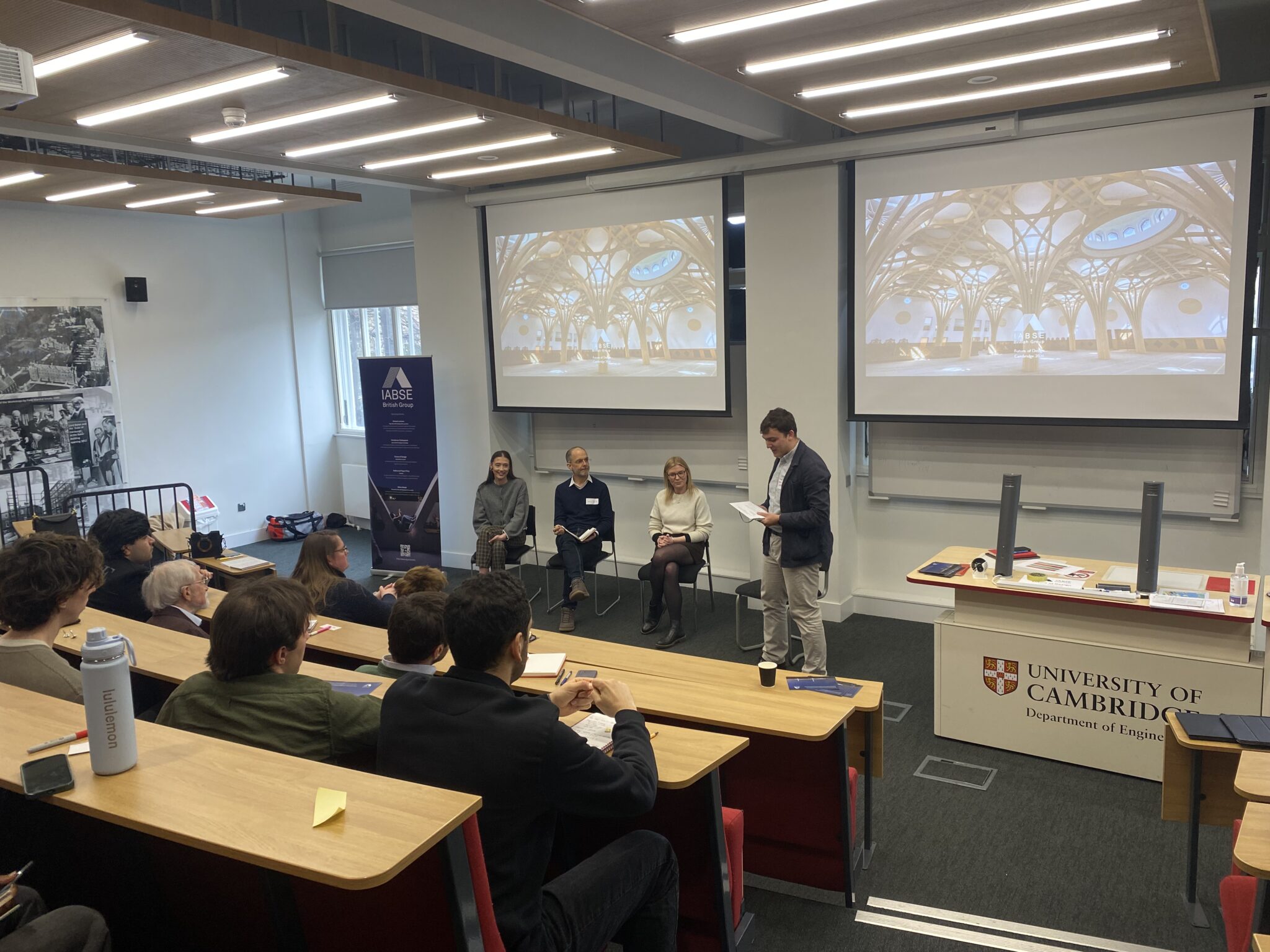
Simon, Niamh, and Anna then joined Daniel Dalton, PhD student at the University of Cambridge, for a panel discussion on Research into Practice: Rethinking the Link in the Age of Climate Emergency. The panel explored whether the current relationship between research and practice is fit for purpose at a time when rapid reductions in embodied carbon, new materials, and fundamentally different design approaches are urgently needed. Framed around a central question – are we moving fast enough, and what is actually stopping us? – the discussion covered industry risk-aversion, the question of who should be driving change, and whether research effort is being directed at the problems that matter most to practice. The exchange was frank, wide-ranging, and clearly resonated with an audience eager to engage with these questions.
After lunch, the afternoon opened with a research and project paper session, offering a platform for early-career engineers and researchers to share their work. Natalia Lydia Papadantonaki (MPhil, Department of Architecture, University of Cambridge) presented her research on preference-learning AI for the selection of fabrication-efficient high-curvature extrusion geometries. David Hoyle, Principal Bridge Engineer at Mott MacDonald, asked whether ancient materials might become the Future of Design, presenting recent work on timber and stone bridges and the case for returning to these materials in a modern structural context. Manjola Caro, Lecturer in Structural Engineering at the University of Bristol, rounded off the session with her research on the bond performance of FRP bars in low-carbon geopolymer concrete.
The afternoon continued with a keynote from Victoria Martin of BDP, who presented a wide-ranging overview of her career leading complex and high-profile projects. A particular highlight was her work on the National Cultural Centre in Athens, a project of impressive scale and ambition that exemplified the structural engineering challenges – and opportunities – that arise at the intersection of civic architecture and national identity.

Arianna Levantesi of Knight Architects then presented early-stage design work on the Trevor Basin Footbridge, a proposed moving footbridge within a UNESCO World Heritage Site in Wales. The project illustrated the delicate balance of technical innovation, heritage sensitivity, and community engagement that defines the best contemporary infrastructure design, and offered a compelling glimpse of a bridge still very much in the making.
The day closed with a keynote from Christopher Matthews, Associate Director at Atelier One, whose wide-ranging and entertaining presentation showcased the extraordinary variety of projects that Atelier One takes on – from the UK’s first concrete shell in 25 years and the structural engineering of major live events, to the adaptive reuse of a North Sea oil platform.
Networking opportunities were woven throughout the day, and attendees gathered afterwards at a local pub to continue the conversation in a more relaxed setting. The IABSE British Group would like to thank all speakers, presenters, and attendees for making the day such a success, and we look forward to welcoming you to the next Future of Design in London in September 2026.